
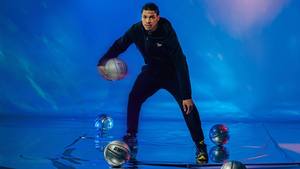
The basketball world is watching as Jalen Brunson tries to lead the New York Knicks to their first NBA championship in a half-century. Among them? Another point guard on a mission to become the league's next All-Star with more heart than height.
Darius Acuff Jr . grew up watching film of Allen Iverson and Stephon Marbury, dreaming about starring in highlight reels of his own.
"We feel like we can go out there and play against anybody," Acuff told ESPN about the mentality of 6-foot-2 Brunson. "I feel like I can hopefully do the same thing one day and it's definitely inspiring to see."
If Brunson has reopened the NBA's door to smaller guards, Acuff -- who measured 6-foot-2 without shoes at the May combine -- hopes to rip it off its hinges.
The projected lottery pick became the first player since "Pistol" Pete Maravich in the late 1960s to lead the SEC in both points (23.5 PPG) and assists (6.4 APG) during his lone season at Arkansas. He demonstrated excellence in every area -- shooting, passing, dribbling -- to raise his projection from mid-first-round to borderline top-five. He also looks like a lost NFL free safety wandering a basketball court at 186 pounds with a 6-foot-7 wingspan.
Like Brunson, Acuff is an anomaly -- a skilled offensive phenom in a game that favors bigger ball handlers. It's no wonder they share a mindset reminiscent of the mentality of the Black Mamba, Kobe Bryant.
"My game speaks for itself," Acuff said at the draft combine. "I just want to go out there and kill every night."
Brunson entered the league nearly a decade ago with two NCAA titles to his name -- as a second-round pick. He was an immediate contributor for the Dallas Mavericks and later became an All-Star in New York, where he bucked expectations about what a player of his size could accomplish. Having that model to follow may have positioned Acuff to avoid some of the early hurdles Brunson encountered. And if Acuff succeeds, he could leave the door Brunson opened ajar for more players with similar measurables and aspirations.
"I think Acuff can open some eyes in the NBA," one Western Conference scout told ESPN. "Brunson has kind of brought back the smaller, scoring, tough physical point guard that can lead a team. And Acuff has some of those traits. He might even have a little more."
Acuff took it personally.
He debuted at No. 12 in ESPN's first mock for the 2026 NBA draft , so before Arkansas' season tipped off, he circled all the games that doubled as opportunities to prove himself against other top prospects -- especially those ranked higher than him.
First came his 21-point performance on 4-for-8 shooting from 3 in a late-November comeback attempt against Cameron Boozer (35 points) and Duke. A few days later, he followed that up with 17 points and 10 assists in a win over Mikel Brown Jr . (22 points, five assists) and Louisville. A few weeks after that, Acuff dropped 27 points against Kingston Flemings (21 points) and Houston. When the conference schedule began in January, Acuff more than doubled Nate Ament 's 13 points with 29 of his own against Tennessee. Then in mid-February, Acuff bested Labaron Philon Jr .'s 35 points with 49 in a double-overtime loss to Alabama.
"The peace was knowing, 'Okay, we're going to play against all of these Elite Eight teams ... It's going to play out on the floor the way it's supposed to,'" Justin Haynes, Acuff's agent, told ESPN about the prospect's mindset going into the campaign.
With each oh-my-goodness performance, Acuff rose in the mocks as decision-makers at the next level began to consider his star power more than his stature, especially with his ability to stretch the floor as an elite 3-point shooter (44% at Arkansas).
"I think the basketball world is starting to rotate back to the point guard, and I think the NBA needs that type of guard back," said Rashad Phillips, Acuff's manager, mentor and trainer. "I think teams are missing that. I feel like teams are playing without quarterbacks in the NBA. They've excluded the quarterback and they're just playing with wide receivers."
The matter of Acuff's size has also hummed in the background of his valuation process, with recent NBA drafts placing a premium on bigger prospects. Only 11 of the 30 players 6-foot-3 or shorter drafted since 2016 cracked the top 10, placing Acuff in rare company, per ESPN Research. According to CraftNBA.com, only 52 of 434 current NBA players are 6-foot-2 or smaller.
Still, Acuff's expansive skill set could be enough of a foundation for him to excel as a pro.
"For a guard like Acuff, he has the ability to get in the paint as well as be able to punish defenses from the perimeter," one Eastern Conference executive said. "Having a skill like being able to shoot the 3 off the bounce is a highly regarded skill for smaller guards in the game today."
Acuff's offensive ability and leadership will also be critical to his success. His path won't come without hurdles, though.
"I think he's going to be challenged defensively and he's going to have to accept and embrace that challenge if he wants to be at the highest level," a Western Conference executive said. "But I think he's got the offensive talent for sure. And those guys are hard to find. When you can do all those things and score the way that he can, an offensive hub in the NBA is not an easy thing to find and he's got that ability."
Mike Conley has survived two decades of change in the NBA.
Drafted in 2007, before the 3-point revolution took hold of the league, the 6-foot-1 point guard knows better than anyone the role isn't what it used to be. It took him nearly a decade to hit his stride -- and a significant adjustment to his game. He went from averaging 3.1 3-point attempts in his first nine NBA seasons to 5.4 over the last 10, earning All-Star honors for the first time in 2020-21 when he attempted a career-high 6.6 3s per game.
"Everybody can handle the ball, everybody can make plays, but not everybody can think the game," he said. "You adapt or die in this league. That's the reason why I'm still here."
Acuff is entering a league that not only favors 3-point shooting more than when Conley first joined, but now also often grants ballhandling responsibilities to the best and biggest athlete on the floor. Look no further than the NBA Finals, where you'll find a 7-foot-4 Victor Wembanyama dribbling more than the league's last generation of big men were ever allowed to -- because today's NBA values playmakers above all.
"It's become so much more of a positionless game, especially on the perimeter in that you're asking yourself, 'Who are your creators?'" one Eastern Conference executive told ESPN.
"Most of the time you don't find a point guard in the truest sense," added another Eastern Conference executive. "You find go-to scorers, ball handlers who are built to score, programmed to score and also have the ability and the instincts and the IQ to get others involved."
That reality has prompted some players who fall into the singular point guard role more than the less-defined combo guard spot to pitch themselves not as stars, but as stabilizers.
Milos Uzan has taken a page out of that playbook. After playing point guard for a Houston team that made the 2025 national championship game then switching to small forward with the arrival of Flemings in 2025-26, Uzan is working out for NBA teams as a point guard, where the projected second-round pick hopes to contribute to a winning culture as a reserve because of the limited slots available to 6-foot-3 perimeter players.
"[Uzan's] role in the NBA is going to be a quarterback," Uzan's agent Maurice Johnson told ESPN. "Most of the second units these days are going to be getting their scoring from the wings or a post, so your job is to be able to control that while also having the threat where they're not laying off you and you're collapsing your own offense because you can't shoot it, so his role is literally the quarterback."
Acuff has bigger aspirations for his role -- he wants to be the star on a stage as big as Brunson's at Madison Square Garden.
Acuff didn't want to listen -- not even to his coaches.
Nursing an injured toe that required a walking boot late in the season when he wasn't playing, the staff couldn't keep him off the floor.
"I mean, [John] Calipari had to pretty much say, "Yo, sit down. You're not practicing today,'" Arkansas assistant Bruiser Flint told ESPN.
Acuff never took those instructions well.
"I didn't want to miss any time for us," he said. "I didn't want [my teammates] to feel like I'm over there just chilling. I wanted to practice with them."
That's the same quality the best point guards coached by Calipari possessed. At Memphis, both Derrick Rose, who led the Tigers to the 2008 national title game, and Tyreke Evans, the No. 4 pick in 2009, demonstrated the same grit Acuff employed under Cal at Arkansas. The legendary coach's fleet of point guard prospects at Kentucky -- including the one starring across from Brunson in the Finals, De'Aaron Fox -- was so strong that two-time NBA MVP Shai Gilgeous-Alexander might not even have a spot among his top five based on college accolades alone.
That's why Calipari's voice mattered when he called Acuff one of the best he has coached.
"Maturity, leadership skills, body language ... it screams 'now.' Your body language screams. His really screamed," Calipari said ahead of his team's Sweet 16 matchup against Arizona. "You look at him now, he's like all the best players that I've coached."
Pedigree and sheer excellence seem to trump any perceived shortcomings for a player like Acuff, who is next in line in Calipari's point guard tree.
The discussion around Acuff's future in the league also magnifies the NBA's obsession with comps and measurements, which have proved costly. Former Minnesota Timberwolves president of basketball operations David Kahn famously picked two point guards over Steph Curry -- who also measured 6-foot-2 without shoes ahead of the 2009 NBA draft -- despite the Davidson star averaging 28.6 points and connecting on 39% of his 3-point attempts in his final college season. Now the same decision-makers who passed on Brunson in 2018 will have to face their own fears and doubts about another promising 6-foot-2 prospect in Acuff.
Measurements don't always tell the full story, either. Ahead of the NBA draft, Acuff was evaluated at P3 Peak Performance Project in Santa Barbara, California, which has data on 70% of the league's active players. The biomechanical analysis firm aims to evaluate players to project how they'll handle the physical demands of the NBA.
"If you get a small guard, what you don't want is a guy who is 6-foot-2, but the movement tools actually have him moving around, covering ground like he's 6-1," said Eric Leidersdorf, resident and head of research and development at P3. "Based on everything that we've seen from Darius, I'm confident that he's going to play bigger than his height suggests. Because he's a tank."
Acuff certainly won't be the tallest guy in the room when the draft begins on June 23, but those childhood film sessions showed him a long time ago that he doesn't have to be.
He just has to be one of the best, which has never been a problem.
"They're getting a great player, a winning player, I would say," Acuff said. "I'm going to do everything for the team to win. ... Whatever they need me to do, I'm going to do it."